


Couples Therapy for Infidelity and Betrayal Trauma in Houston, TX
WHEN THE DISTANCE HAS BECOME THE DEFAULT
When You're Still Together and Somehow Farther Apart
Maybe it didn't happen all at once. There wasn't necessarily a single cause, just a slow accumulation of conversations that didn't land, repairs that didn't quite hold, and a distance that grew so gradually that by the time it was noticeable, it felt like it had always been there.
For some couples the presenting issue is a specific rupture: infidelity, a betrayal, a moment when trust broke in a way that changed the geometry of the relationship. For others it's the pattern, the argument that keeps happening in different forms, the dynamic where one person pursues and the other withdraws, the intimacy that has quietly receded without either person deciding to let it go.
You still care about each other. That's the part that makes it complicated. How could something that used to be so easy become so effortful? The path forward isn't obvious.
Whatever brought you here, you deserve help navigating it.


What Couples Therapy Actually Addresses
Why the Same Argument Keeps Happening
Most recurring conflict in relationships isn't really about what it appears to be about. The fight about dishes, about time, about who said what these surface arguments are almost always expressions of something underneath: unmet attachment needs, accumulated bids for connection that weren't recognized, or nervous system responses to perceived threat that are faster than the conscious mind.
Understanding this changes what therapy is working on. The goal isn't to win the argument or even resolve the specific content of the disagreement. It's to understand what the argument is actually expressing what each person needs, what each person fears, and what the cycle is doing to both of you and to build a different way of responding to each other in those moments.
We also offer couples
ketamine-assisted therapy for partners where standard approaches have reached a ceiling where entrenched patterns and defended positions have made the ordinary work of connection difficult to access.
A TEAM BUILT FOR THIS
How We Work With Couples at Houston Healing Collective
At Houston Healing Collective, we understand that one of the hardest parts of starting couples therapy is the question of whether it's safe whether the therapist will take sides, whether what gets said in the room will be used against you, whether being honest will make things better or worse.
Our work is grounded in two of the most research-supported approaches available: the Gottman Method and Emotionally Focused Therapy (EFT). Both treat the relationship itself as the client the dynamic between two people, not one partner's adjustment or fault assignment.
Our work is deliberately structured to hold both partners equally. Neither person is the identified patient. Neither person's perspective is more valid than the other's. The therapist's role is not to adjudicate who is right but to help both people understand what is happening between them and to create the conditions where something different becomes possible.

Clinicians working with couples at HHC:
Jamie Weiser, LMFT-A — Supervised by Lindsay McCarthy PhD, LMFT-S, LCDC | Texas License #206082
Working together, you may find:
A clinical space where both perspectives are held with equal care, no sides, no fault assignment
Gottman Method and EFT approaches that work with the cycle, not against each other
Couples ketamine therapy therapy for partners where defended positions have made standard work difficult to access
A pace that belongs to both of you, nothing is forced, and the work moves at the rate the relationship can tolerate
The full backing of a collaborative specialist team
Not Sure If You're at the Point Where Therapy Would Help?
Most couples wait longer than they need to. The consultation is free, a real conversation about where you are and whether couples therapy makes sense right now.
WHAT CLIENTS OFTEN NOTICE
What's Possible Through Couples Therapy in Houston
Couples therapy can't promise the relationship becomes easy or that conflict disappears. What many couples describe is a change in what the conflict feels like, less like a threat to the relationship and more like something the relationship can hold.
Less Reactive, More Present
Some couples find the same trigger lands differently, with more space around it.
A Different Kind of Conversation
Partners may start to hear what was always being said but missed.
Connection That Feels Deliberate
Intimacy that felt distant may become something both people can reach for.
Couples Therapy Built for Different Needs
Couples Therapy Approaches at Houston Healing Collective
At HHC, couples therapy is not a single method applied uniformly. The approach is shaped by what the relationship is navigating, and our range of modalities reflects that.
The Gottman Method
Developed from over four decades of research into what makes relationships succeed or fail, the Gottman Method gives couples a specific, practical framework for understanding their dynamic. The work addresses the four patterns most predictive of relationship breakdown, criticism, contempt, defensiveness, and stonewalling, and builds the skills to interrupt them: repair after conflict, turning toward each other's bids for connection, rebuilding friendship and fondness, and creating shared meaning. This is structured, evidence-based work with real tools to take into daily life.
Emotionally Focused Therapy (EFT)
EFT focuses on the emotional bond between partners, the attachment cycle underneath the surface conflict. It helps both people identify the negative cycle they're caught in, understand what each person is reaching for and afraid of, and respond to each other in ways that create safety and closeness rather than triggering the cycle again. EFT is particularly effective for couples dealing with emotional disconnection, high-conflict cycles, or trust that has been damaged over time.
Couples Ketamine-Assisted Therapy
For partners where defended positions and accumulated hurt have made the ordinary work of connection difficult to access, ketamine-assisted therapy creates a window where defenses soften, presence deepens, and material that has been difficult to reach becomes more available. This work is always embedded in an ongoing therapeutic relationship, with full preparation before and integration after each session. It is offered where the clinical picture genuinely calls for it, in collaboration with a physician partner trained in ketamine treatment.
Most couples work draws on Gottman and EFT, sometimes one, often elements of both. Couples ketamine-assisted therapy is available for partners where those approaches have reached a ceiling. The pace belongs to both of you. Nothing moves without understanding and agreement from each partner

WHAT THE RELATIONSHIP MAY START TO FEEL LIKE
When the Cycle Starts to Break
There may come a point in the work when one of you says something in the middle of a familiar pattern, and it lands differently than it did before. Not because the words are new. Because something in how they're received has changed. The other person hears what was actually said rather than what the cycle trained them to hear.
That moment is what this work is building toward. The ability to be in the dynamic without being completely captured by it. To feel the pull of the old pattern and have just enough room to respond rather than react.
For disconnected couples, it may look like love and intimacy feeling more in reach. Less effort. More presence. The relationship feels like something both people are choosing again rather than something that's simply still in place.
For couples navigating infidelity or betrayal, it may look like trust rebuilding. Not a return to how things were, but something more deliberate and honestly constructed than what existed before.
WHERE TO START WHEN STARTING FEELS LIKE TOO MUCH
Beginning Couples Therapy in Houston
Not every couple who contacts us is in crisis. Some are managing. But they notice a disconnection that they fear will only continue without help.
1
Step 1: Reach Out
Fill out our contact form or call us. One partner reaching out is enough to start. You don't need to have your partner on board before the first conversation.
2
Step 2: Talk With Us
We'll schedule a consultation at no cost. A real conversation about where the relationship is, what you've already tried, and whether couples therapy at HHC is the right fit.
3
Step 3: Begin Together
If it feels right, we'll schedule your first session. The work begins from where the relationship actually is, not from an ideal starting point that neither of you recognizes.
WHAT THE WORK REVEALS
How Couples Come to See Their Dynamic Differently
As the work deepens, many couples arrive at a different understanding of what has been happening between them.
- That surface arguments were really two people reaching for connection in ways the other couldn't recognize.
- That pursuing and withdrawing were two different nervous system responses to a shared underlying fear.
- That understanding the cycle together helped it start to change.
- That rebuilding after betrayal didn't mean returning to what
existed before. In some ways, what they built was more honest. - That they wished they had sought help sooner, before the crisis.

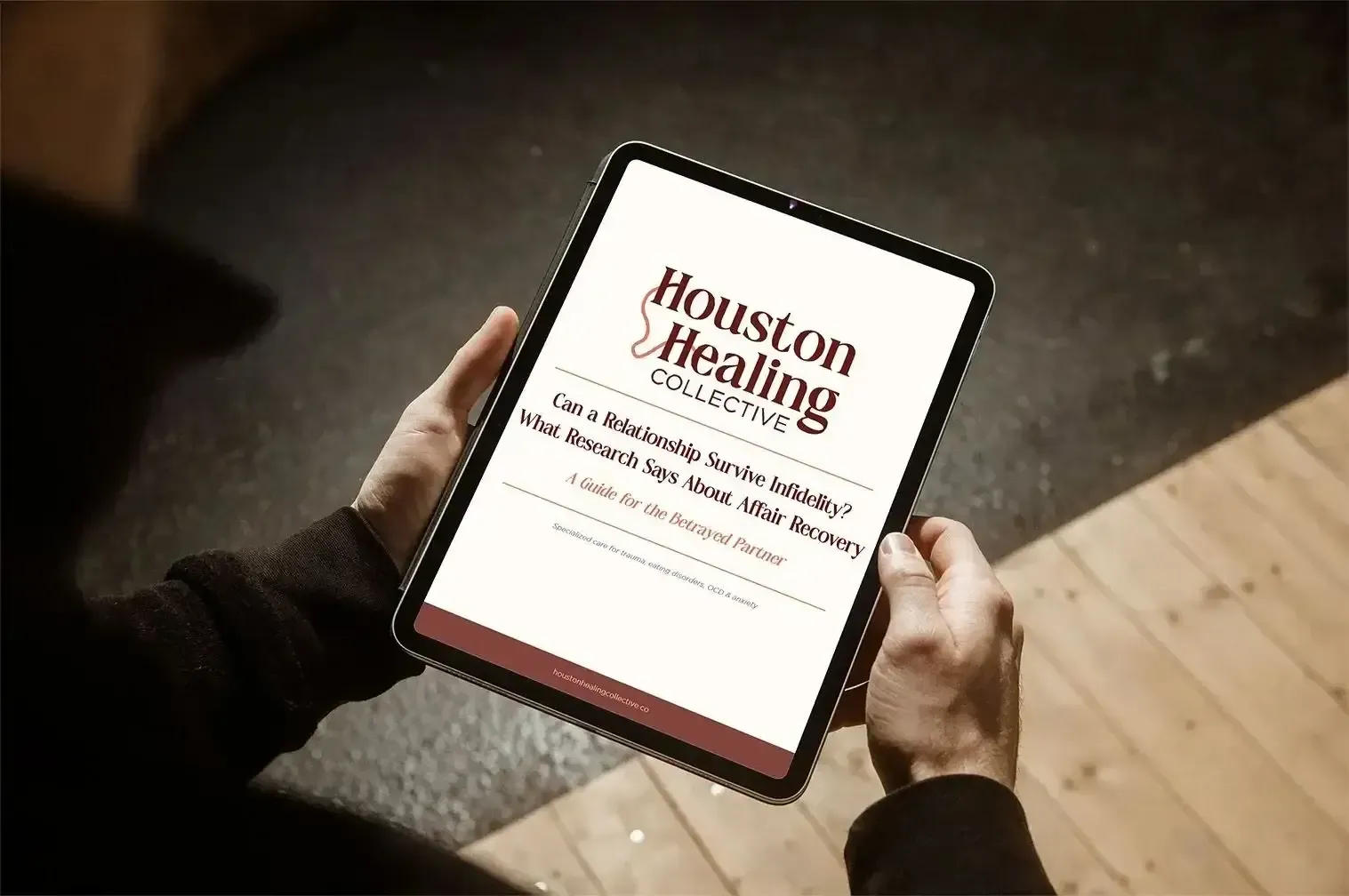
Can a Relationship Survive Infidelity? What the Research Says on Affair Recovery
A free resource on betrayal trauma: what the research actually shows about affair recovery, what the work requires from both partners, and how to know whether your relationship has what it takes to recover.

QUESTIONS WE HEAR OFTEN
Frequently Asked Questions About Couples Therapy in Houston
My partner is reluctant to come. Should I still reach out?
Yes. One person reaching out is enough to start a conversation. Many couples begin with one partner more motivated than the other, that ambivalence is normal and doesn't determine the outcome. The consultation is a low-pressure place to start. If your partner is open to hearing about it rather than committing to it, that is enough for a first step. Individual therapy is also available if couples work isn't accessible right now, and individual work often creates the conditions that make couples therapy possible later.
Is couples therapy just for relationships in crisis?
No. Some of the most effective couples work happens before the crisis, when patterns are visible but haven't yet calcified, and when both people still have significant motivation to change them. If you're aware that something has shifted and the direction concerns you, that awareness is a reasonable reason to start. Waiting until things are worse doesn't make the work easier.
How is this different from just talking to each other more?
The content of the conversation is rarely the problem. Most couples have tried talking, and found that the same conversations produce the same results, or escalate. What therapy adds is a third presence that can slow the cycle down, name what's actually happening beneath the surface, and help both people hear each other rather than respond to the pattern. The therapist is not a moderator. The work is structural, changing what the dynamic does, not just what gets said.
What's the difference between Gottman and EFT? Which one will we use?
Both are research-supported approaches that work with the relationship dynamic rather than assigning fault. Gottman tends to be more structured and skills-oriented, practical tools for specific patterns. EFT works more at the level of emotional attachment and the cycle underneath the conflict. Many couples benefit from elements of both. At your consultation and first session, your therapist will get a clear picture of what your relationship is bringing and which approach or combination, makes the most clinical sense.
Is everything we say in couples therapy confidential?
Yes, with specific exceptions. As licensed clinicians, your therapist is bound by ethical guidelines and state law to protect what is shared in sessions. There are narrow mandatory exceptions, certain safety situations, but outside of those, nothing is disclosed without your consent. One important note specific to couples therapy: what one partner shares individually with the therapist outside of joint sessions is a clinical question we address clearly at the start of treatment, so both partners understand the structure from the beginning.
ONE CONVERSATION IS ENOUGH TO START
When You're Ready to Stop Having the Same Fight
If something has been building for a while, if the distance has become the default, or if something happened that changed the shape of the relationship, that is worth bringing to someone trained to work with it.
The consultation is free. A real conversation, not a commitment. We'll tell you honestly whether we think we can help.