



What Causes Eating Disorders? The Missing Trauma Link

Jennifer Lancaster • April 30, 2026

Eating disorders develop from a combination of factors — genetics, environment, diet culture, perfectionism, and social media all play a role. But for many people these explanations are part of a larger, more complex picture.

There’s a deeper connection that most of these explanations miss — one that research is increasingly confirming and that has significant implications for how eating disorders are treated. And if you’re trying to recover from an eating disorder, understanding this connection might be the most important thing you read today.

The Well-Known Causes of Eating Disorders

Genetics play a real role. Research consistently shows eating disorders run in families — people with a first-degree relative who has had one are significantly more likely to develop one themselves. This doesn’t mean an eating disorder is inevitable, but it does mean some people carry a biological vulnerability that other factors can activate.

Environment and early family dynamics shape the relationship with food and the body from an early age — homes where food was controlled or criticized, parents who dieted or commented on bodies, the relational template through which a child learns what their body means and what food is for.

Diet culture and societal pressure create a constant external message that the body is something to be managed, shrunk, and improved. The normalization of restriction, the cultural glorification of thinness — all of it contributes to an environment where disordered eating can take hold.

These factors are real, and they matter. But for a substantial portion of people with eating disorders — particularly those whose symptoms are severe, persistent, or treatment-resistant — something else is also at work. Something the standard explanations don’t fully account for.

Eating Disorders and Trauma: The Connection Most People Miss

Trauma is one of the strongest and most underrecognized risk factors for developing an eating disorder — and the research is increasingly unambiguous about this.

A 2022 study published in Frontiers in Psychology found that adolescents who experienced four or more adverse childhood experiences were 5.7 times more likely to be in the high eating disorder risk group than those without trauma exposure. A systematic review examining PTSD and eating disorder treatment outcomes confirmed that trauma and PTSD are highly prevalent among people with eating disorders — and that trauma history consistently predicts more severe symptoms and poorer treatment outcomes in programs that don’t address it (Day et al., 2023).

These are significant clinical findings. And they point toward something most eating disorder treatment programs still don’t adequately address.

The connection between trauma and eating disorders isn’t coincidental — it’s mechanistic. Trauma, particularly childhood trauma, relational trauma, and experiences of abuse, neglect, or chronic emotional harm, fundamentally alters the nervous system’s relationship with the body. It creates dysregulation, disconnection, and shame that the eating disorder then develops, in many cases, to manage.

Restriction creates control and numbness when the nervous system is overwhelmed. Bingeing temporarily floods a system chronically deprived of comfort, safety, or enough. Purging releases tension. Overexercising manages anxiety. These behaviors aren’t irrational; they’re what the nervous system reaches for when the experience becomes too much to carry any other way.

Understanding this doesn’t minimize the eating disorder. It helps explain it and is key in informing effective treatment early. This is the foundation of how we approach eating disorder therapy in Houston — treating the trauma, not just the disorder.

Childhood Trauma and Eating Disorders: What the Research Shows

The connection between childhood trauma and eating disorders is one of the most consistently documented findings in the research literature — and one of the least addressed in standard clinical practice.

Adverse childhood experiences — physical, emotional, and sexual abuse, neglect, and household dysfunction — are significantly associated with eating disorder development across multiple studies and populations. A comprehensive 2022 review by Timothy Brewerton synthesized decades of evidence on exactly how childhood trauma and PTSD shape eating disorder development, severity, and treatment outcomes ( Brewerton, 2022, Journal of Eating Disorders ).

The findings are clinically significant. Childhood trauma doesn’t just increase the risk of developing an eating disorder — it shapes how severe it becomes, how early it starts, and how well it responds to treatment. People with eating disorders and trauma histories tend to have more severe symptoms, higher rates of co-occurring conditions, and poorer outcomes in programs that don’t truly address the trauma component.

A 2023 systematic review confirmed this directly: trauma history negatively predicted eating disorder treatment outcomes across multiple studies, with childhood trauma identified as a significant predictor of poorer treatment response (Day et al., 2023, Trauma, Violence, & Abuse ).

This is why people can go through treatment — sometimes multiple rounds — and still find themselves back where they started.

PTSD and Eating Disorders: When They Occur Together

For some people, the trauma and eating disorder connection is explicit: they have a PTSD diagnosis alongside their eating disorder, and the two are clearly intertwined. For others, the trauma history is present but hasn’t been formally recognized or processed — and the eating disorder has developed, in part, as a way of managing the symptoms that trauma left behind.

Both presentations are common, and both deserve treatment that addresses the full picture.

When PTSD and eating disorders co-occur, the clinical picture is more complex and typically requires more specialized treatment. The intrusive memories, hypervigilance, emotional dysregulation, and disconnection from the body that characterize PTSD all intersect with and amplify eating disorder symptoms in specific ways.

Intrusive trauma memories can trigger restriction or bingeing as a way to manage the flood of emotion. Hypervigilance around the body — a PTSD symptom — can become fixation on appearance, weight, or food. Emotional numbing, another PTSD feature, can manifest as disconnection from hunger and fullness cues. The body, which is already a site of traumatic memory, becomes a site of eating disorder behavior as well.

Treating the eating disorder without treating the PTSD — or even acknowledging it — means working on the surface of a much deeper problem. The symptoms may shift temporarily, but the underlying source that is driving them remains untouched.

Why Trauma Changes Everything About Eating Disorder Treatment

If trauma is driving the eating disorder — and the research suggests it frequently is — then treatment focused only on food behaviors, thought patterns, and nutritional rehabilitation is working at the wrong level.

Skills-based approaches matter. Learning to tolerate distress, interrupt compulsive behaviors, and follow a meal plan are necessary parts of eating disorder treatment — we use them too. But they’re a floor, not a ceiling.

What creates lasting change is addressing what’s underneath: the nervous system patterns, the body disconnection, the shame rooted in real experiences of harm. Most standard eating disorder programs — including many residential and intensive outpatient programs — don’t have the specialized training to do this work. That gap is often exactly why people complete treatment and still find themselves back where they started.

At Houston Healing Collective, our eating disorder therapists are trained in integrative, trauma-focused approaches that treat both the eating disorder and the underlying trauma — not sequentially, but from the beginning.

How We Treat Trauma and Eating Disorders in Houston

Our approach combines structured eating disorder treatment with trauma-focused modalities chosen specifically for their ability to reach what’s underneath.

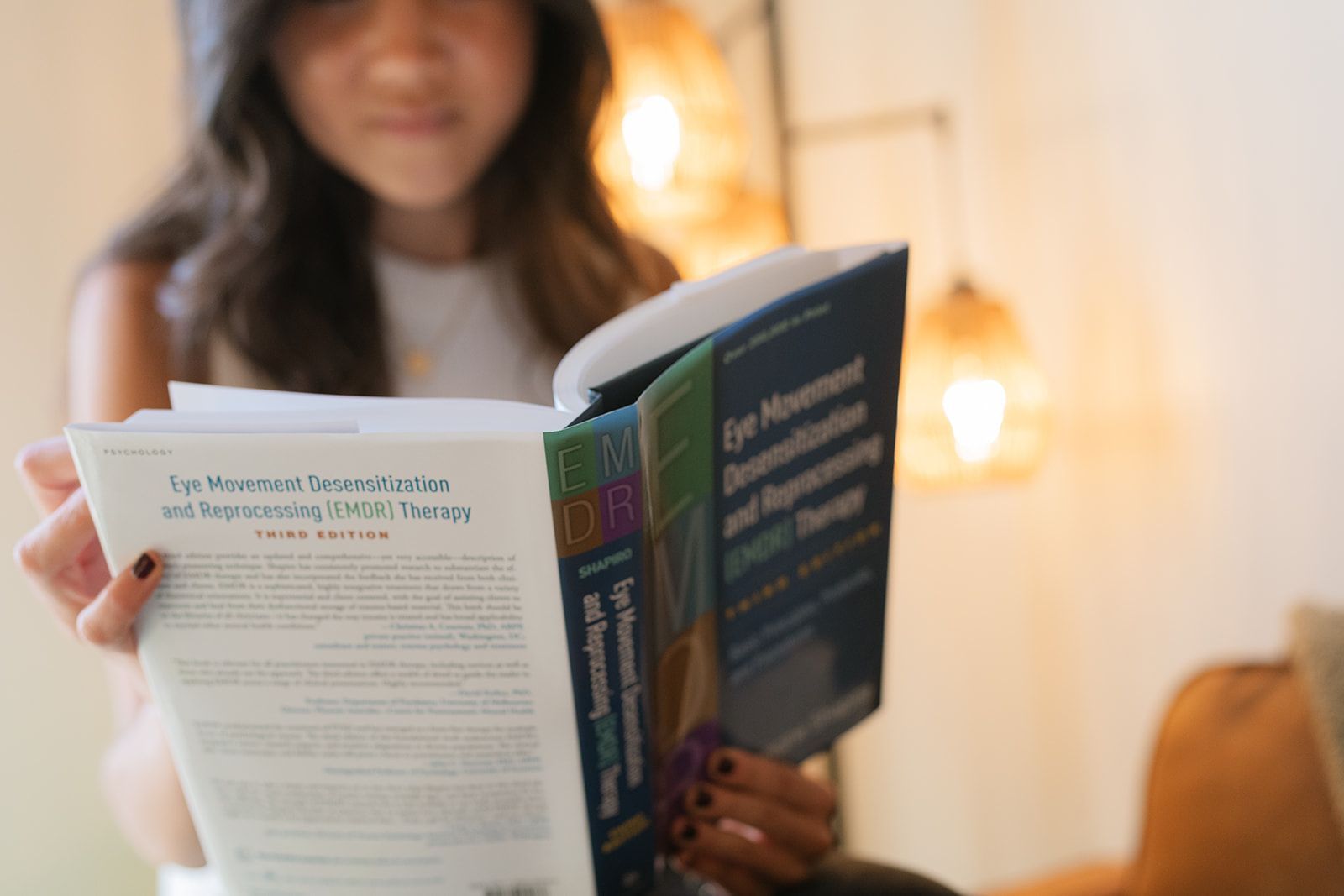
EMDR targets the memory networks where traumatic material is stored — the experiences that shaped the nervous system’s relationship with the body and food. For many people it creates shifts that behavioral approaches alone can’t produce.

IFS-informed therapy works with the internal parts organized around the eating disorder and the trauma — the protectors, the managers, the exiled experiences the eating disorder has been trying to contain. Working with these parts rather than fighting them is often what allows real movement.

Trauma-informed yoga and somatic approaches address the body directly — rebuilding physical experience, supporting nervous system regulation, and restoring interoception. You can read more about how we use trauma-informed yoga for eating disorders as part of this work.

Ketamine-assisted therapy is available where the layers run particularly deep — promoting neuroplasticity and opening access to material other approaches haven’t reached.

Skills-based work, meal support, and nutritional rehabilitation are woven throughout. We don’t skip the foundation. But we know it’s a mistake to stop there, and we’ve seen the difference

Looking for Eating Disorder Therapy in Houston?

Whether you’re exploring eating disorder therapy for the first time or you’ve been through treatment before and are still struggling, we want you to know that the trauma connection is often what gets missed — and addressing it is exactly what our Houston eating disorder therapists are trained to do.

At Houston Healing Collective, our eating disorder therapists work with people whose eating disorders have roots in trauma, whose symptoms have been persistent, and who need an approach that goes beneath the surface. If that’s you — or someone you love — we’d welcome a conversation.

References

Brewerton, T. D. (2022). Mechanisms by which adverse childhood experiences, other traumas and PTSD influence the health and well-being of individuals with eating disorders throughout the life span. Journal of Eating Disorders, 10 , 194. https://doi.org/10.1186/s40337-022-00696-6

Convertino, A. D., & Mendoza, R. R. (2023). A systematic review of the effect of PTSD and trauma on treatment outcomes for eating disorders. Trauma, Violence, & Abuse, 25 (2), 947–964. https://pmc.ncbi.nlm.nih.gov/articles/PMC10913314/

Day, S., Hay, P., Tannous, W. K., Fatt, S. J., & Mitchison, D. (2023). A systematic review of the effect of PTSD and trauma on treatment outcomes for eating disorders. Trauma, Violence, & Abuse, 25 (2), 947–964. https://doi.org/10.1177/15248380231167399

Kovács-Tóth, B., Oláh, B., Kuritárné Szabó, I., & Túry, F. (2022). Adverse childhood experiences increase the risk for eating disorders among adolescents. Frontiers in Psychology, 13 , 1063693. https://doi.org/10.3389/fpsyg.2022.1063693

Frequently Asked Questions

  • What Are the Main Causes of Eating Disorders?

    Eating disorders develop from a combination of genetic, environmental, psychological, and sociocultural factors. These include genetic predisposition, family environment and early experiences around food and the body, cultural pressure and diet culture, and — critically — trauma. Research increasingly identifies trauma as one of the strongest and most underrecognized risk factors for eating disorder development. A 2022 study found that adolescents who experienced four or more adverse childhood experiences were 5.7 times more likely to be in the high eating disorder risk group than those without trauma exposure (Kovács-Tóth et al., 2022, Frontiers in Psychology).

  • Is Trauma a Cause of Eating Disorders?

    Yes — research consistently shows trauma as a significant driver of eating disorder development for many people. A 2024 study found that up to 50% of people with eating disorders have a trauma history, with rates climbing to 74% among those with PTSD. Trauma shapes the nervous system’s relationship with the body in ways that eating disorder behaviors often develop to manage — making trauma-focused treatment an essential component of lasting recovery for many people

  • What Is the Connection Between Childhood Trauma and Eating Disorders?

    Childhood trauma — including abuse, neglect, and other adverse childhood experiences — is significantly associated with eating disorder development, severity, and treatment resistance. A 2022 comprehensive review by Timothy Brewerton found that childhood trauma shapes not just the risk of developing an eating disorder but the clinical severity and response to treatment. People with eating disorders and childhood trauma histories tend to have more severe symptoms and poorer outcomes in programs that don’t address the trauma component.

  • Do PTSD and Eating Disorders Occur Together?

    Yes — frequently. Among people with PTSD, rates of eating disorder symptoms reach as high as 74% in some studies. When PTSD and eating disorders co-occur, the clinical picture is more complex and requires treatment that addresses both simultaneously. Treating the eating disorder without acknowledging and treating the PTSD often results in temporary symptom relief rather than lasting change.

  • Why Doesn’t Standard Eating Disorder Treatment Always Work?

    Standard eating disorder treatment focuses primarily on food behaviors, thought patterns, and nutritional rehabilitation. For people whose eating disorder is rooted in trauma, this approach addresses the surface without reaching what’s driving the symptoms. A 2024 systematic review found that trauma history negatively predicted eating disorder treatment outcomes across multiple studies — confirming that trauma-informed treatment is not optional for this population, it’s essential.

  • Where Can I Find Trauma-Focused Eating Disorder Therapy in Houston?

    Houston Healing Collective offers integrative, trauma-focused eating disorder therapy in Houston for individuals whose eating disorder is rooted in trauma, PTSD, or childhood adverse experiences. Our approach combines evidence-based eating disorder treatment with EMDR, IFS-informed therapy, trauma-informed yoga, and ketamine-assisted therapy. Contact us to schedule a free 20-minute consultation.

Houston Healing Logo

Healing Beneath the Surface

If you are in Houston and something in this article felt familiar, you don't have to keep figuring it out alone. Reach out today and book a free 15 minute consultation.


Recent Posts

Person holding EMDR bilateral stimulation buzzers during a ketamine-assisted EMDR therapy session
By Jennifer Lancaster May 3, 2026
KA-EMDR combines low-dose ketamine with EMDR to reach trauma that standard therapy can't. Houston Healing Collective explains how it works and who it's for.
Three people sitting and talking on a patio with wicker chairs and a small table of flowers
By Jennifer Lancaster April 30, 2026
When someone in a family is struggling with an eating disorder, the whole family feels it. Mealtimes become something to get through rather than something to share. Conversations get careful — everyone measuring their words, afraid of saying the wrong thing. Parents don’t know whether to push or back off. Partners feel shut out. And […] The post Family Therapy for Eating Disorders in Houston: A Trauma-Informed Approach appeared first on houstonhealingcollective.co.
Two people talking in a bright counseling office, one holding a notebook.
By Jennifer Lancaster April 28, 2026
If you’ve spent years at war with your body — cycling through diets, avoiding mirrors, shrinking yourself in photographs, or lying awake cataloguing everything you wish were different — you’ve probably heard a range of advice to practice more discipline, more self-acceptance, or more gratitude for what your body can do.
Jennifer Lancaster practicing somatic breathwork in trauma-informed yoga for eating disorders
By Jennifer Lancaster April 26, 2026
Trauma-informed yoga for eating disorders isn't about exercise, it's about body reconnection. Houston therapists explain how somatic practice supports recovery.
Stack of eating disorder recovery books on a marble countertop at a Houston eating disorder therapy
By Jennifer Lancaster April 26, 2026
Eating disorder recovery is hard when trauma goes untreated. Houston therapists explain the missing link, and how trauma-focused therapy changes everything.
Couple in a therapy session discussing desire discrepancy and sexual intimacy in Houston
By Jennifer Lancaster April 25, 2026
Different sex drives create real distance in relationships. Desire discrepancy affects most couples, learn what causes it and how couples therapy in Houston helps.
A couple in a  Houston therapy session with their therapist, ketamine-assisted couples therapy
By Jennifer Lancaster April 25, 2026
Some couples understand their patterns but still can't break free. Learn how ketamine-assisted couples therapy in Houston reaches where talk therapy can't.
Client lying on a couch with eye mask during a ketamine-assisted psychotherapy session in Houston
By Jennifer Lancaster April 25, 2026
Ketamine-assisted psychotherapy combines low-dose ketamine with guided therapy to access what talk alone can't reach. Houston Healing Collective explains how.
Trauma therapist listening to a client during a betrayal trauma therapy session in Houston, Texas
By Jennifer Lancaster April 24, 2026
Betrayal trauma goes deeper than hurt feelings, it rewires your sense of safety. Houston trauma therapists explain what it is and how recovery is possible.
Houston trauma therapist Jamie attentively listening to a client during a complex PTSD therapy
By Jennifer Lancaster April 24, 2026
Complex PTSD doesn't respond to standard therapy. Houston therapists explain why talk therapy falls short and what deeper trauma treatment offers instead.

I'm Jennifer Lancaster

Most of the people I work with look fine from the outside. High-achieving, capable, holding everything together. Underneath that, there's usually longstanding complex trauma, a lot of self-criticism, and a deep exhaustion from never quite getting to the root of it.


I've spent 15 years training specifically in the areas that are considered really difficult to treat. I'm not a cookie-cutter therapist, and I work best with people who aren't looking for quick fixes. If this feels like you, feel free to book a free 15-minute consultation.

Recent Posts:

Person holding EMDR bilateral stimulation buzzers during a ketamine-assisted EMDR therapy session
By Jennifer Lancaster May 3, 2026
KA-EMDR combines low-dose ketamine with EMDR to reach trauma that standard therapy can't. Houston Healing Collective explains how it works and who it's for.
Three people sitting and talking on a patio with wicker chairs and a small table of flowers
By Jennifer Lancaster April 30, 2026
When someone in a family is struggling with an eating disorder, the whole family feels it. Mealtimes become something to get through rather than something to share. Conversations get careful — everyone measuring their words, afraid of saying the wrong thing. Parents don’t know whether to push or back off. Partners feel shut out. And […] The post Family Therapy for Eating Disorders in Houston: A Trauma-Informed Approach appeared first on houstonhealingcollective.co.
Two people talking in a bright counseling office, one holding a notebook.
By Jennifer Lancaster April 28, 2026
If you’ve spent years at war with your body — cycling through diets, avoiding mirrors, shrinking yourself in photographs, or lying awake cataloguing everything you wish were different — you’ve probably heard a range of advice to practice more discipline, more self-acceptance, or more gratitude for what your body can do.
Jennifer Lancaster practicing somatic breathwork in trauma-informed yoga for eating disorders
By Jennifer Lancaster April 26, 2026
Trauma-informed yoga for eating disorders isn't about exercise, it's about body reconnection. Houston therapists explain how somatic practice supports recovery.
Stack of eating disorder recovery books on a marble countertop at a Houston eating disorder therapy
By Jennifer Lancaster April 26, 2026
Eating disorder recovery is hard when trauma goes untreated. Houston therapists explain the missing link, and how trauma-focused therapy changes everything.
Couple in a therapy session discussing desire discrepancy and sexual intimacy in Houston
By Jennifer Lancaster April 25, 2026
Different sex drives create real distance in relationships. Desire discrepancy affects most couples, learn what causes it and how couples therapy in Houston helps.
A couple in a  Houston therapy session with their therapist, ketamine-assisted couples therapy
By Jennifer Lancaster April 25, 2026
Some couples understand their patterns but still can't break free. Learn how ketamine-assisted couples therapy in Houston reaches where talk therapy can't.
Client lying on a couch with eye mask during a ketamine-assisted psychotherapy session in Houston
By Jennifer Lancaster April 25, 2026
Ketamine-assisted psychotherapy combines low-dose ketamine with guided therapy to access what talk alone can't reach. Houston Healing Collective explains how.
Trauma therapist listening to a client during a betrayal trauma therapy session in Houston, Texas
By Jennifer Lancaster April 24, 2026
Betrayal trauma goes deeper than hurt feelings, it rewires your sense of safety. Houston trauma therapists explain what it is and how recovery is possible.
Houston trauma therapist Jamie attentively listening to a client during a complex PTSD therapy
By Jennifer Lancaster April 24, 2026
Complex PTSD doesn't respond to standard therapy. Houston therapists explain why talk therapy falls short and what deeper trauma treatment offers instead.